Every agency talks about communication. It’s in every pitch deck, every proposal, every introductory call. “We keep our clients informed.” It sounds like a given.
It isn’t.
After 23 years running digital projects, I’ve seen two versions of how communication fails. The first: clients go quiet, you assume everything is fine, and then they explode at delivery because they’d been building up concerns for weeks. The second: clients want to be in every detail, message you daily, and slowly derail the team’s ability to actually build anything.
Both are communication failures. And both are the agency’s fault.
Communication Is Your Responsibility, Not Theirs
Clients don’t know how to be clients. They’ve hired you because they don’t have the expertise to do what you do — which means they also don’t know what good project communication looks like from their side. If you leave that gap open, they’ll fill it with anxiety, micromanagement, or silence.
Your job is to design the communication before the project starts, not react to it after things get tense.
Here’s what I’ve landed on after running this badly and then better: the system that actually works is boring. It’s not a clever tool or a proprietary framework. It’s consistency, clarity, and being available.
The Actual System
Async by default. Basecamp message boards have been my anchor for years. Every meaningful update, decision, or question goes there — not in a chat thread that disappears into scroll history, not in an email chain that loses half the team by reply number four. A message board gives the client a running record they can refer back to. It also gives your team a single source of truth.
Questions asked before they become problems. This one sounds obvious and almost nobody does it well. If something is unclear early — a requirement, a scope boundary, a technical assumption — surface it immediately. Don’t build around it hoping it won’t matter. A question raised in week one costs nothing. The same question raised at delivery costs a relationship.
Weekly check-ins, kept short. Scheduled calls, same time every week, thirty minutes maximum. Not to report everything — to give the client a moment to ask what they’re wondering about and hear a human voice confirm things are moving. The rhythm matters more than the content. Clients who know a call is coming stop sending anxious messages between calls.
Shared dashboards for visibility. Not every client wants this, but for larger projects it removes a whole category of “where are we?” conversations. When they can see the status themselves, they stop asking.
The Part Nobody Wants to Admit
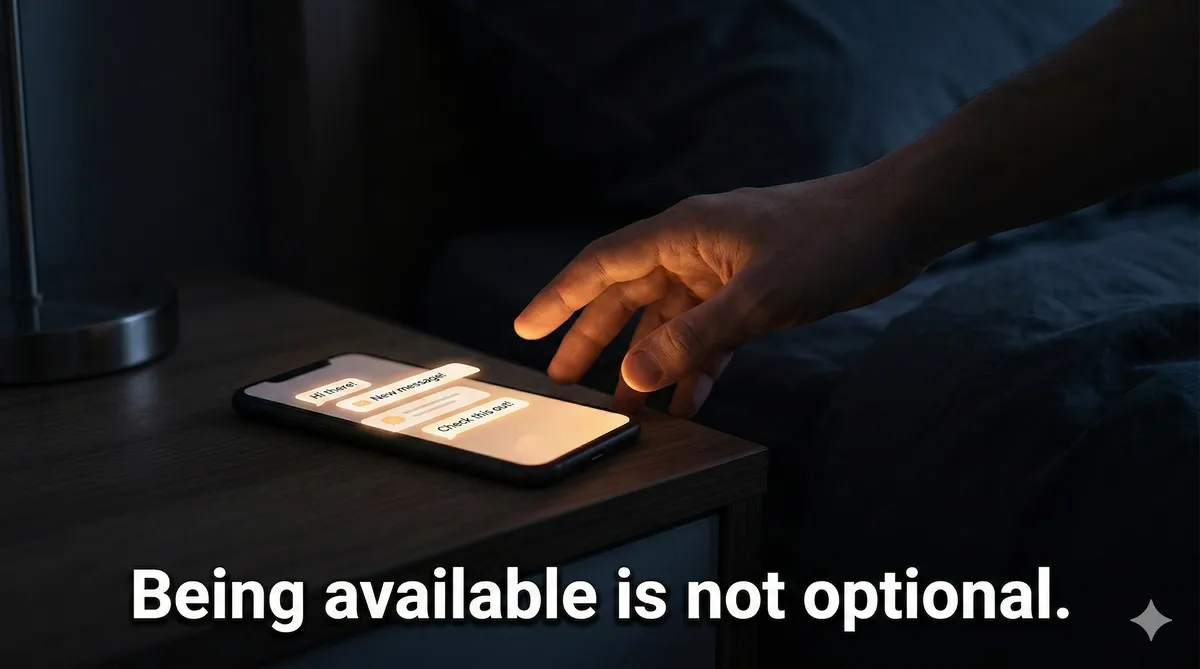
WhatsApp. Viber. Slack. I use all of them with clients, and I’ll be honest: it’s not best practice. It blurs boundaries, it creates an expectation of instant response, and it means your evenings are never fully yours.
But here’s the reality after two decades of agency work: if you want clients to genuinely trust you, being available is part of it. Not performatively available — actually reachable when something matters to them. A quick reply at 8pm that says “got it, we’ll handle it tomorrow” costs you three minutes and buys you enormous goodwill.
I’m not saying this is healthy. I’m saying it’s true. And any agency owner who tells you they’ve fully solved the availability problem is either running a much larger team than me or not being straight with you.
The line I try to hold: async tools for everything that can wait, chat apps for anything that has genuine urgency, and weekly calls to keep the relationship warm. That combination has never failed me on a project where I stuck to it.
What Tight Communication Actually Produces
The best outcome isn’t a client who’s impressed by your updates. It’s a client who stops worrying about the project entirely because they trust it’s being handled.
I had a project where we ran this system clean — consistent async updates, weekly calls, questions surfaced early, chat available for urgent things. Midway through, the client told me they’d stopped thinking about the project between our calls. Not because they didn’t care. Because they trusted it.
That’s the goal. Not communication for its own sake. Communication designed to earn trust and then get out of the way.
Still working out how to systematize the early communication setup — the part where you establish norms with a new client before the first update is due. Right now it lives in my head and in how I run kickoffs. Getting that out of my head and into something repeatable is something I’m folding into ArwenHQ’s onboarding flow. More on that when it’s actually built.